Colorado Residents Get $225 Off Any eBike!

Ather Rasool | 18 hours ago

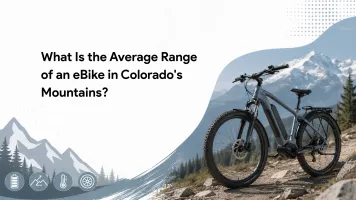
What Is the Average Range of an eBike in Colorado's Mountains?

Manufacturer range numbers rarely survive contact with Colorado's elevation. A battery rated for 60 miles on flat ground might only carry a rider 25 to 30 miles once real climbing gets involved. 


This guide breaks down what actually determines e-bike range in the mountains and what to expect on Front Range terrain.

What "Range" Really Means for Colorado Riders

Range isn't a single number since it changes with every hill, headwind, and degree of temperature drop. Anyone planning a mountain outing should think in terms of a range window rather than a fixed mileage, which is exactly why the team behind Elevated E-Bikes' rental fleet walks riders through expected range before they head out.


• Battery capacity:

Measured in watt-hours, this sets the theoretical ceiling for how far a bike can travel.

• Elevation gain:

Climbing drains a battery far faster than flat riding, regardless of total distance.

• Rider and cargo weight:

Heavier loads make the motor work harder on every incline.

• Temperature:

Cold weather reduces how much usable energy a lithium-ion battery can deliver.

How Elevation Changes Your Real-World Range

Manufacturer range claims are almost always tested on flat pavement, which explains the gap riders notice once mountain grades enter the picture, a pattern well documented by outlets. Here's what actually happens to your battery once the road tilts upward.


The 100-Meter Rule

As a rough guide, an e-bike battery needs roughly 10 to 15 additional watt-hours for every 100 meters of elevation gained. On a ride with 2,000 feet of climbing, that adds up fast even before wind or weight are factored in.


Grade Steepness vs Total Distance

A 6 percent grade can use more than double the energy of flat ground over the same distance. This is why a short, steep climb can drain more battery than a long, gentle one.


Local Climbs Front Range Riders Actually Face

Popular routes like Lookout Mountain near Golden or the trails inside Golden Gate Canyon State Park involve sustained climbing that pedal-assist bikes feel immediately. Riders tackling these routes should plan for noticeably less range than a flat commute would suggest.


The Return Trip Isn't Free Range

Coasting downhill uses very little battery, but it doesn't meaningfully restore what the climb consumed. Total ride range should be estimated around the climbing effort, not the round-trip mileage.


Assist Level Matters More Than Bike Class

A Class 1 bike in a low assist setting can outlast a Class 2 or 3 bike running in Turbo or Boost mode on the same climb. Choosing a lower assist level on tough grades is one of the simplest ways to stretch a charge.


Cold Temperatures at Altitude

Lithium-ion batteries lose usable capacity as temperatures drop, and Colorado's high country cools quickly outside summer months. A battery that delivers 40 miles in July might only manage 30 to 32 on a cold spring morning.

What Actually Determines Your Mountain Range

Beyond elevation, a handful of bike-specific factors decide how far a charge actually carries a rider. These apply whether you're on a paved path or a mountain trail.


Battery Capacity

Larger batteries, measured in watt-hours, simply store more usable energy. A 750Wh pack will outlast a 400Wh pack on the same climb by a wide margin.


Motor Type

Mid-drive motors use the bike's own gearing to climb efficiently, while hub motors tend to draw more power on steep grades. That efficiency difference becomes obvious the moment a route turns uphill.


Rider and Cargo Weight

Every extra 20 pounds can cut range by roughly 10 to 20 percent on hilly terrain. Panniers, hydration packs, and passengers all count toward that total.


Tire Choice and Pressure

Wide, knobby tires create more rolling resistance than narrow, smooth ones, and underinflated tires make it worse. Checking pressure before a mountain ride is a quick way to protect your range.


Riding Style and Stops

Frequent stopping and restarting burns more energy than maintaining a steady climbing pace. Technical, stop-and-go singletrack will drain a battery faster than a smooth fire road with the same elevation gain.


Altitude Itself Isn't the Problem

Thin mountain air affects a rider's lungs, not an electric motor's output. Unlike a gas engine, an e-bike motor doesn't lose power at elevation, so the range drop riders notice comes from the climbing itself, not the altitude.

Choosing the Right Battery for Colorado Trail Riding

Matching battery size to the terrain you actually ride prevents the frustration of turning back early. If you're regularly tackling Front Range climbs, it's worth browsing higher-capacity e-bikes at Elevated E-Bikes before committing to a smaller commuter-style battery.

Battery Size Typical Flat-Terrain Range Typical Colorado Mountain Range Best For
400Wh–500Wh 30–50 miles 15–25 miles Short local climbs, paved paths
500Wh–750Wh 45–65 miles 25–40 miles Regular trail and foothill riding
750Wh+ 60–90 miles 35–55 miles Multi-hour mountain rides, passes

Conclusion

E-bike range in Colorado's mountains almost always lands well below the number printed on the box, and elevation gain is the biggest reason why. Matching battery size to your typical climbing, riding a lower assist level on steep grades, and accounting for cold temperatures will get you a far more realistic estimate.

People Also Ask

Can I swap batteries mid-ride to extend range in the mountains?

Yes, many e-bikes support a spare or swappable battery, and carrying one is common practice for longer mountain routes. Swapping takes only a couple of minutes on most models. It's a practical way to double your range without carrying a much heavier single battery.


Do e-bike rental shops in Colorado provide extra batteries for longer rides?

Some rental shops offer spare batteries or larger-capacity bikes for riders planning bigger mountain routes. It's worth asking about elevation gain when booking so the shop can match you with an appropriate battery size. This is especially useful for multi-hour rides into the foothills.


Is regenerative braking a real range boost on Colorado descents?

Most consumer e-bikes don't include meaningful regenerative braking, so descents mainly just use very little power rather than adding it back. A handful of higher-end models offer limited regen, but the effect on total range is usually small. Riders shouldn't count on downhill sections to significantly extend a charge.


How much range should I expect on a day trip to Golden Gate Canyon State Park?

Expect noticeably less than your bike's advertised flat-ground range given the park's sustained climbing. A mid-size 500Wh to 750Wh battery typically covers a solid half-day of riding there with moderate assist use. Starting with a full charge and a conservative assist level is the safest approach.


Does riding in eco mode really extend my range that much in the mountains?

Yes, dropping from Turbo or Boost to a lower assist level can meaningfully stretch a charge, sometimes by 30 percent or more on the same climb. The tradeoff is more physical effort from the rider to maintain speed. Many riders switch to a higher assist level only on the steepest sections and use eco mode elsewhere.